
A contractor in Surat once ordered “16mm TMT, Fe500” for a three-storey building. The engineer’s drawing said Fe500D. Nobody caught the missing letter until the bars were already on site. The rate difference was small. The delay, the re-order and the argument that followed were not.
That single letter D changes how a bar behaves when the structure is under stress. If you are about to place a TMT order, this is the one detail worth getting right.
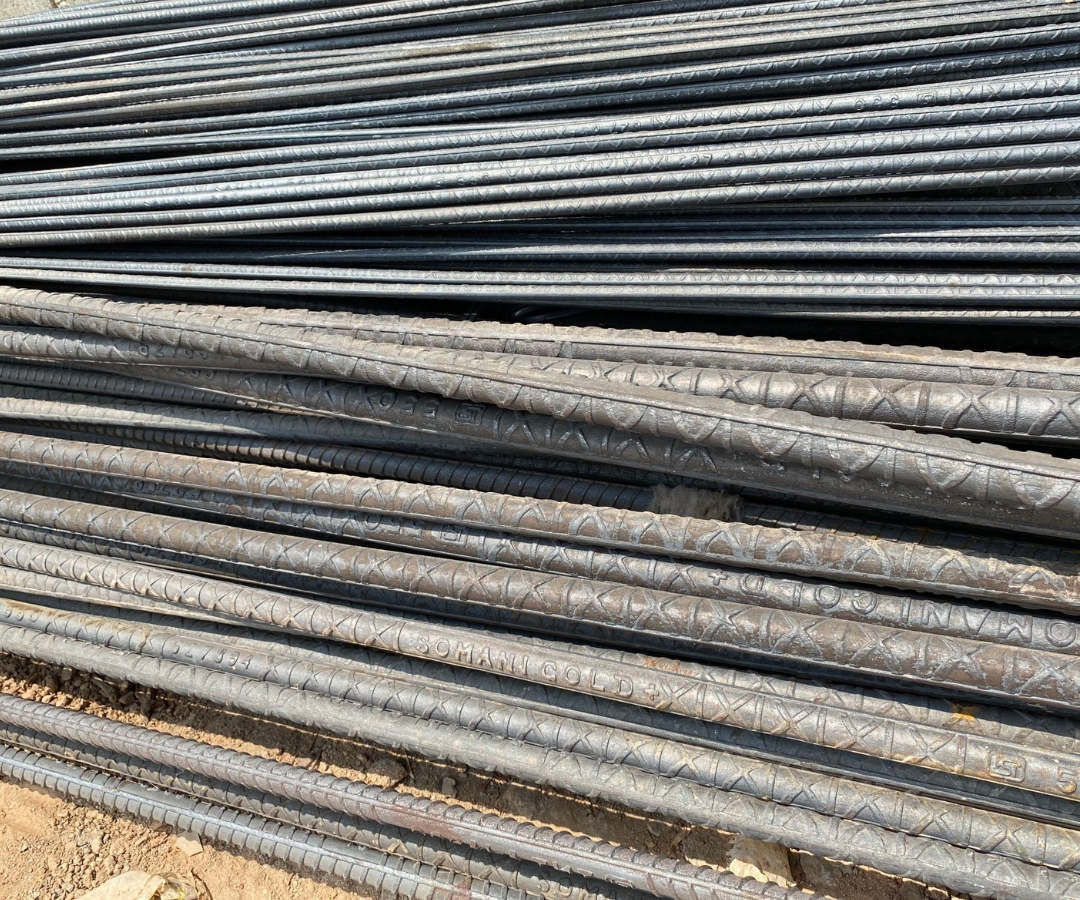
Quick answer: Fe500 and Fe500D have the same yield strength (500 MPa). The D grade is made to be more ductile, so it stretches and bends more before it breaks. Fe550D is stronger (550 MPa) and also ductile. For most residential and commercial buildings, Fe500D is the safe default. Use Fe550D when your structural engineer specifies it. Plain Fe500 suits less demanding work where ductility is not called out in the drawing. Always buy the grade written on the structural drawing, not the cheapest one.
What Do Fe500, Fe500D and Fe550D Actually Mean?
The number is the minimum yield strength in megapascals (MPa). Fe500 means 500 MPa. Fe550 means 550 MPa. The letter D stands for ductility.
Ductility is how much a bar can stretch and bend before it snaps. In a normal load, you never see it. In an earthquake or an overload, it is what lets a structure bend and give warning instead of failing suddenly.
Fe500 vs Fe500D vs Fe550D: Side-by-Side
| Point | Fe500 | Fe500D | Fe550D |
|---|---|---|---|
| Minimum yield strength | 500 MPa | 500 MPa | 550 MPa |
| Ductility | Standard | Higher | Higher |
| Behaviour under overload | Less warning before failure | Bends and stretches more | Bends and stretches more |
| Typical use | General construction where drawing allows | Most buildings, slabs, columns, beams | High-rise and heavily loaded members, if specified |
| Cost | Lowest | Usually a small premium | Usually a premium over Fe500D |
Exact elongation and strength-ratio limits are set in IS 1786. Ask your supplier for the mill test certificate to see the actual values for your batch.
Which Grade Should You Buy?
- Fe500D if your drawing does not say otherwise and you are building a house, apartment block, shop or small commercial building. It is the common choice for good reason.
- Fe550D if your structural engineer has specified it, usually for taller buildings or heavily loaded members where a thinner bar can carry the same load.
- Fe500 only where the drawing allows it and ductility is not a requirement.
Parts of Gujarat sit in higher seismic zones. Ask your structural engineer which zone your site falls in and which grade the design assumes. If you are unsure, buy the grade on the drawing and keep the drawing page with your order.

How Grade Affects Your Cost
Higher grades usually cost a little more per tonne. But Fe550D can carry more load per bar, so some designs use a smaller diameter or fewer bars. Do not switch grade to save money without your engineer’s approval. A cheaper bar that does not match the design is not a saving.
How to Check You Are Getting the Right Bar
- Look at the markings. Genuine TMT bars carry the brand, size and grade rolled into the bar along its length.
- Ask for the mill test certificate. It shows yield strength, tensile strength and elongation for the batch.
- Check the BIS mark. Ask for the licence details of the manufacturer.
- Check size and weight. Weight per metre in kg is roughly diameter squared divided by 162. A 16mm bar is about 1.58 kg per metre. See our full TMT bar weight chart.
- Weigh the delivery. Compare the weighbridge slip with the invoice.
What to Send When You Ask for a TMT Quote
- Grade (Fe500, Fe500D or Fe550D)
- Diameter and quantity for each size, in tonnes or number of bars
- Preferred brand or mill, if any
- Delivery location and unloading arrangement
- Whether you need the test certificate with the delivery
A complete request gets you an accurate quote faster. For more on avoiding costly orders, read our 7 steel buying mistakes and the full TMT rebars buying guide.
Frequently Asked Questions
What is the difference between Fe500 and Fe500D?
Both have the same minimum yield strength of 500 MPa. Fe500D is made to be more ductile, so it can stretch and bend more before breaking.
Is Fe500D better than Fe500?
For earthquake resistance and safety margin, yes. That is why it is the common choice for buildings.
Is Fe550D better than Fe500D?
It is stronger, but not automatically better for your job. Use it when the structural design calls for it.
Can I use Fe550D instead of Fe500D?
Only with your structural engineer’s approval, since the design may assume a specific grade.
Which TMT grade is best for a house?
Fe500D is the usual choice. Confirm with your engineer and the drawing.
How do I know my TMT bars are genuine?
Check the rolled-in markings, the BIS licence and the mill test certificate, and weigh the delivery.
Need TMT Bars in Bhavnagar or Surat?
Tell us the grade, diameter, quantity and delivery location, and we will confirm current stock and send a quote. See what we supply in Surat and Bhavnagar, browse our TMT bars, or read what local stock means for your project.
Call 7226060911 or send your requirement below.
